Bently Nevada’s monitoring page now opens with the words “Cordant™ Devices” in the position where the company name used to sit — but the brand being promoted is not new, and for a spares buyer almost nothing about the part numbers has changed. As of 28 October 2026 the hero on the vendor’s industrial-monitoring landing page reads “PROTECTION, SENSING, AND CONDITION MONITORING / Cordant™ Devices / Built on trusted Bently Nevada™ technologies”. Archived copies of the same page show that exact label already in use inside the page body on 17 June 2026, while the headline position still carried “Bently Nevada” on 15 July 2026. The October change is therefore a promotion of an existing portfolio brand into the headline, plus a swap of the featured customer case to Braskem — not the launch of a new product line. What it does signal is worth planning around: the vendor now presents, and will increasingly support, the 3500 rack in front of you as one layer inside a hardware-plus-software-plus-services offer rather than as a standalone instrument.
By TenBN Editorial · Published 28 October 2026 · 11-minute read

Quick answer: what changed, and what did not
- What changed: the headline of Bently Nevada’s monitoring landing page. It now leads with a portfolio brand (“Cordant™ Devices”) instead of the company name, and the featured case study is now Braskem.
- What did not change: any part number, form factor, slot assignment or sensor interface. A 3500/42M ordered against a Cordant label is the same module that was ordered before it.
- The label is older than the headline. The phrase “Cordant™ Devices” and its definition appear in the archived page copy of 17 June 2026 and 15 July 2026; they are absent from the usable captures of 22 January, 5 March, 20 April and 15 May 2026.
- Cordant itself is three and a half years old. Baker Hughes described it publicly as “a new… integrated suite of solutions for asset performance management and process optimization” on 6 March 2023, in an announcement of a collaboration with bp.
- Under the label sit three device families: Machinery Protection, Sensing, and Condition Monitoring. Of those, the machinery-protection rack and the proximity-transducer chain are the two we actually stock; the newer wireless and portable collectors are not.
- The buyer-relevant consequence is commercial, not technical: more of the value story now sits in software subscriptions, analytics and service tiers, which changes how a spares budget and a support entitlement should be negotiated.
What the page says today, in the vendor’s own words
Two verbatim blocks carry most of the weight, and it is worth reading them side by side because they say different things.
The current hero is short and structural: an eyebrow (“PROTECTION, SENSING, AND CONDITION MONITORING”), a headline (“Cordant™ Devices”), and a subhead that keeps the old brand subordinate (“Built on trusted Bently Nevada™ technologies”). That ordering is the whole story of the change — the portfolio brand is now the noun, and Bently Nevada is the qualifier.
The body copy, which has been on the page since at least mid-June, is more concrete: “Backed by proven expertise in asset condition monitoring and machinery protection, Cordant™ Devices deliver a comprehensive portfolio of monitoring systems, advanced sensing technologies, and asset protection services.” Read literally, that sentence puts services inside Devices, which is unusual for a hardware category and is the clearest textual evidence that the vendor does not treat the boundary between box and labour as a purchasing boundary. The same page family describes the offer as “a true plant-wide unified hardware, software, and services asset health solution” and cites “500+ asset engineers across the globe” behind it.
For comparison, the hero that the archive shows on every usable capture from 22 January through 15 July 2026 read: eyebrow “Industry Innovator for Over 60 Years”, headline “Bently Nevada”, subhead “Edge to enterprise asset health management”. Nothing about the product range differed. The framing did.
| Archive date | Eyebrow | Headline | Subhead | “Cordant™ Devices” in page? | Braskem card? |
|---|---|---|---|---|---|
| 22 Jan 2026 | Industry Innovator for Over 60 Years | Bently Nevada | Edge to enterprise asset health management | No | No |
| 5 Mar 2026 | Industry Innovator for Over 60 Years | Bently Nevada | Edge to enterprise asset health management | No | No |
| 20 Apr 2026 | Industry Innovator for Over 60 Years | Bently Nevada | Edge to enterprise asset health management | No | No |
| 15 May 2026 | Industry Innovator for Over 60 Years | Bently Nevada | Edge to enterprise asset health management | No | No |
| 17 Jun 2026 | Industry Innovator for Over 60 Years | Bently Nevada | Edge to enterprise asset health management | Yes (body copy) | No |
| 15 Jul 2026 | Industry Innovator for Over 60 Years | Bently Nevada | Edge to enterprise asset health management | Yes (body copy) | No |
| Live, 28 Oct 2026 | Protection, sensing, and condition monitoring | Cordant™ Devices | Built on trusted Bently Nevada™ technologies | Yes (hero and body) | Yes |
How to read this table. The archive is not continuous. The last usable capture before the change is 15 July 2026; the next capture of the page, on 4 October 2026, returned an HTTP 403 and holds no page content. So the honest bound on the headline swap is after 15 July and on or before 28 October. A date of 24 October is entirely consistent with that window and is the date the change came to our attention, but the archive alone cannot confirm it to the day. Anyone repeating “launched 24 October” as a product milestone should treat it as the date of observation, not the date of introduction.
The label is older than the headline — and older than this year
The most common misreading of a homepage change is to treat it as a release date. In this case the underlying brand has a documented trail that predates the hero by years, and the device taxonomy in the navigation predates it by months.
| Date | What was published | Why it matters to a buyer |
|---|---|---|
| October 2021 | Baker Hughes and Augury state they have been working together since October 2021 to build on the asset performance management capabilities in the company’s portfolio. | The analytics layer was being assembled well before the Cordant name existed. |
| 6 March 2023 | Baker Hughes announces a collaboration with bp on “Cordant™, a new Baker Hughes integrated suite of solutions for asset performance management and process optimization”. bp deploys OnePM, named as a Cordant asset strategy solution, in selected Gulf of Mexico assets. | This is the introduction of Cordant as a suite — three and a half years before the October homepage change. |
| November 2024 | Chinese trade coverage of the China International Import Expo describes Cordant as a digital solutions platform combining advanced hardware with enterprise software-as-a-service and analytics, covering asset performance management, process optimization and energy and sustainability management, with Orbit 60 presented as the condition-monitoring and asset-protection system inside it. | Confirms the SaaS shape of the commercial model and Orbit 60’s position under the label. |
| June 2025 | A Baker Hughes memorandum-of-understanding announcement defines Cordant in Chinese-language release copy as an industrial solution combining hardware, software and services, delivering real-time operating insight across assets, processes and energy management. | The “hardware + software + services” formulation the October page leans on is at least a year old. |
| 17 June 2026 | “Cordant™ Devices” and its portfolio definition are present in the body of the Bently Nevada monitoring page; the headline is still the company name. | The device brand existed as a page section four months before it became the headline. |
| 21 September 2026 | Baker Hughes states on LinkedIn that Cordant was recognised as a representative vendor in the Gartner Market Guide for Asset Performance Management software for the seventh consecutive year. | A seventh consecutive year implies continuous presence in that market category since roughly 2020 — further evidence the brand is not new. |
| On or before 28 October 2026 | The Bently Nevada monitoring page headline becomes “Cordant™ Devices”; the featured case becomes Braskem. | Promotion of an established label into first position, not an introduction. |
One internal inconsistency is worth flagging rather than smoothing over. The Devices page leads with “+60 years and pioneers in condition monitoring”, while the Sensing page beneath it claims “over 10 million sensors installed worldwide and seven decades of experience”. Both are plausible — the second counts the proximity-probe lineage, the first the monitoring-system business — but they are not the same number, and neither is a lifecycle commitment for the module in your rack. Treat them as marketing context, not as data for an asset register.
What Cordant™ Devices actually covers
The navigation under Devices is the most useful part of the change, because it is the only place the vendor states its own hardware boundary explicitly. There are three families, and they are not equally relevant to someone buying spares.
| Family | Named by the vendor | What lands on a purchase order | In our stock list? |
|---|---|---|---|
| Machinery Protection | Orbit 60, 3500 Series Systems; the wider protection page also lists ADAPT Overspeed ESD, the 2300 Vibration Monitor series and the 1900/65A general-purpose monitor. | Racks, monitors, interface and power modules — for example a 3500/05 rack, 3500/20 RIM, 3500/22M TDI, 3500/25 Keyphasor, 3500/60 temperature monitor, 3500/15 power supply or a 3500/92 communication gateway. | Yes — 3500 Series, both as modules and as a documented system. |
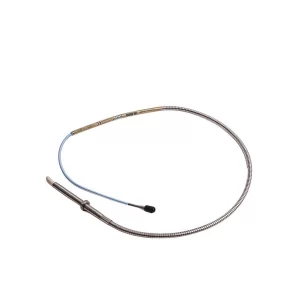
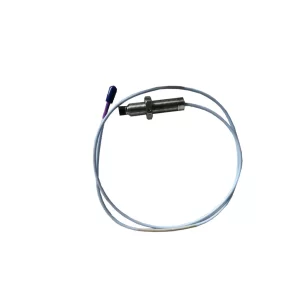
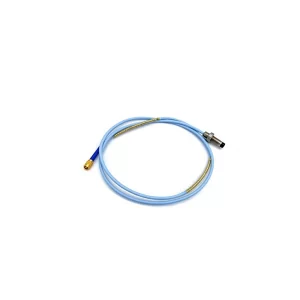
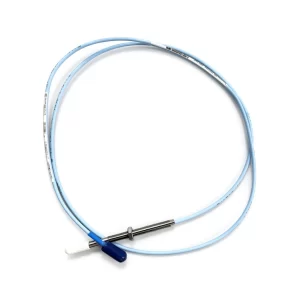
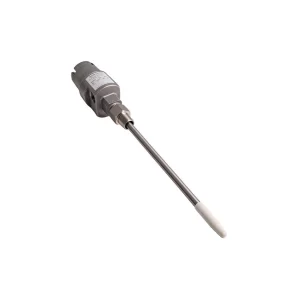
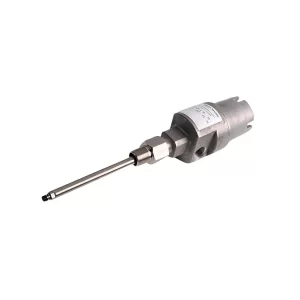
| Sensing | Proximity Probes, Sensors & Transducer Systems; the family page subdivides into proximity, pressure, acceleration and velocity, wireless, hydro, transmitters and accessories. | The probe-and-cable chain: an 8 mm proximity probe, a 3300 XL proximitor, the matching extension cable, a Velomitor CT velocity transducer, or casing accelerometers such as the 200350 series. | Yes — the 3300 XL chain and its accessories. |
| Condition Monitoring | Orbit DCM, Ranger Pro wireless vibration sensor, SCOUT200 series portable collectors (SCOUT220-IS two-channel and SCOUT240-IS four-channel, rated for ATEX Zone 1 and CSA Class 1 Zone 1), plus Orbit 60 again. | Edge collectors, wireless nodes and handheld route-based data collectors — devices bought per channel or per route rather than per rack slot. | No. We do not hold Orbit 60, Orbit DCM, Ranger Pro or SCOUT200. See where we stand. |
Notice what the taxonomy does to the old product logic. Under the previous framing, a plant bought a protection rack and, separately, a condition-monitoring system. Under this one, both sit in the same Devices group, with Orbit 60 appearing in both the protection and the condition-monitoring lists. That is a deliberate architectural claim — one data model, one edge layer, one vendor — and it is the reason the vendor can put services inside a hardware definition without anyone noticing the category error.
The Braskem case, number by number
The featured case that replaced the previous one is a Baker Hughes study of Braskem, the Brazilian petrochemical producer, covering multiple sites in Brazil with compressors and turbines in scope. The published solution is Cordant™ Asset Health, explicitly described as built on System 1™, with three named analytics types: thermodynamics efficiency, Decision Support and Anomaly Detection.
The headline numbers are vendor-published and should be read as such: more than US$100,000 in return on investment within fourteen months, with additional value still under assessment, and US$39,000 attributed to avoided downtime and production loss at the butadiene plant. Four specific findings are named.
| Case | Machine | What the analytics found | Downstream consequence for a maintenance desk |
|---|---|---|---|
| 1. Start-up monitoring | Butadiene centrifugal compressor | Incipient surge detected during start-up. | Surveillance during transient conditions, not just at steady state. This is where a 3500/22M transient data interface earns its keep — without the high-resolution waveform, the event is a trip report, not a diagnosis. |
| 2. Instrument failure detection | Butadiene screw compressor | Intermittent instrument failure, found by combining Decision Support with Anomaly Detection. | An “instrument” failure here is a probe, proximitor or cable failure. It argues for holding the sensor chain as a spare, not only the monitor module. |
| 3. Energy efficiency | Charged gas compressor | Mini-flow malfunctions detected, contributing to improved energy efficiency. | An efficiency finding that requires process data alongside machine data — the strongest case in the study for the software layer being the product. |
| 4. Early vibration assessment | Butadiene screw compressor | Increased vibration identified early by Anomaly Detection, supporting proactive maintenance. | A classic reliability-window win; the spares consequence is lead time on the rack hardware, not the algorithm. |
Two honest caveats. First, the case publishes no baseline: it does not state the software subscription cost, so “$100,000+ ROI” is a gross value figure, not a net one, and the fourteen-month payback is measured against an unstated denominator. Second, three of the four findings concern compressors. If your plant’s critical assets are steam turbines or pumps, the transferable content is the analytics method, not the result. Our own coverage of a reciprocating-compressor retrofit at Natref — spare slots in an existing rack, connected to System 1 — is the closer analogue for most brownfield sites, and we have written it up separately, along with the compressor application page for the wider duty class.
What this does not change
- Part numbers and interchangeability. Nothing in the Cordant reorganisation renames a module. A 3500/42M is a 3500/42M. Our standing analysis of 3500 support status versus Orbit 60 is unaffected by the homepage wording.
- The installed base. The vendor states more than 80,000 3500 systems installed worldwide. A brand promotion does not move that population, and the company has separately stated that it has not instituted a forced obsolescence programme.
- The board-generation question. The 2016–2017 RoHS PCBA refresh — the change from green to blue lead-free boards — remains the practical dividing line when you match a spare to a slot. That is a manufacturing fact, not a brand fact; see the PCBA refresh explained and how to plan a 3500 spares kit around it.
- Warranty and lifecycle entitlements. Those are set by contract with the manufacturer. A marketing label on a landing page changes none of them.
What it does change, and how to plan for it
The change is real, but it is commercial. Four consequences are worth acting on.
1. Expect the value story to move up-stack. The Devices page now sits between a software layer (Cordant Applications, with asset strategy, asset health, defect elimination, asset integrity, energy and sustainability, and process optimization named as the portfolio areas) and a services layer (Cordant Services). The vendor’s own alliances page names Augury, C3.ai, Microsoft and SAP. A hardware quotation that arrives as “the edge layer of Cordant” is being positioned for renewal economics that live in the software line, not the rack line. When you budget, separate the two explicitly, because they renew on different cycles and are negotiated by different people. Our piece on System 1 reaching twenty years and 10,000-plus active users is the better guide to what the software layer actually has to sustain.
2. “Spare Parts Analysis” is now a named service line. Under Strategic Consulting and Advisory, the vendor lists RAM analysis, maintenance strategy development and optimisation, master data development, availability and capacity analysis, life cycle costing — and Spare Parts Analysis. That is the vendor selling your spares policy back to you as consulting. It is often genuinely useful; it is also a signal that stocking decisions are being treated as a revenue line rather than a support obligation. If you take the service, keep the resulting kit list as an internal document with your own rationale attached, because the leverage in a renewal negotiation comes from being able to re-source independently.
3. Support entitlement becomes the differentiator, not the hardware. The Devices page leans on “500+ asset engineers” and an onsite-and-remote programme-management model, and the Services page promises a dedicated customer success manager working to “a success plan with mutually agreed KPIs” and application support resolved “within set service level agreements”. Those are contractual objects. Before assuming that a Cordant-branded installation inherits any particular response time, check which tier you actually hold — we have documented the support channels and M&S tiers as published.
4. Balance-of-plant coverage is the growth vector, and it is where the hardware story gets thin. The same corporate motion shows up in the vendor’s machine-health service for balance-of-plant assets, in the Arauco contract covering roughly 3,000 sensors with System 1, and in the first remote factory acceptance test in Latin America. Plant-wide coverage means many more, cheaper sensing points per dollar of hardware — which is precisely the market that wireless nodes and portable collectors address, and none of which we stock. Our honest read: the balance-of-plant machine-health offer is where a monitoring programme actually expands, and the Arauco contract is what the scale looks like in one order. The parent-company financials behind all of it are in our Q3 2026 results piece.
How to buy against a Cordant label: a six-step checklist
- Ask for the device, not the suite. Get the exact model and revision — rack, module, probe, proximitor, cable — written on the quotation. Portfolio names do not appear on a nameplate.
- Ask which of the three families the line item belongs to. Protection, sensing and condition monitoring have different lead times, different failure modes and different spares logic.
- Separate hardware, software and services on the purchase order. If a single number is quoted, request the split. Renewal cycles differ and so does the negotiating counterparty.
- Get the support tier in writing. Named service levels, response times and the escalation route — not a reference to a global engineer population.
- Record the board generation at the slot level. Especially where pre-2017 and post-2017 stock mix in one rack. Colour is a first filter, not proof of compliance.
- Keep a second source for the consumables. Sensors, cables and housings fail more often than monitors and are the items where a single-vendor programme shows its cost. Cross-check against the product index, the technical document library and the commonly asked questions before you commit to one channel.
Where we stand, plainly
We are an independent supplier of Bently Nevada spares. We stock the machinery-protection and sensing layers that the Cordant Devices taxonomy describes — 3500 Series modules and racks, and the 3300 XL probe, proximitor, cable and transducer chain — because that is where the installed base fails and where a plant needs a part this week rather than a strategy review next quarter.
We do not stock Orbit 60, Orbit DCM, Ranger Pro or the SCOUT200 portable collectors, and we are not a Cordant software or services reseller. If a quotation you are holding covers those items, it came from the manufacturer or its channel, and the entitlements attached to it are theirs to define. What we can do is supply the hardware that a mixed-generation rack actually consumes, and tell you which generation you have. If that is useful to you, send us your model list or start from the system pages and the news index.
Frequently asked questions
Is Cordant™ Devices a new product line?
No. It is a portfolio label. The phrase and its definition are present in the body copy of the Bently Nevada monitoring page on the 17 June 2026 archive capture and absent from the usable captures of 22 January, 5 March, 20 April and 15 May 2026, and the underlying Cordant suite was publicly introduced on 6 March 2023. What changed in October 2026 is that the label moved into the page headline and the featured customer case changed to Braskem.
Do my 3500 part numbers change because of Cordant?
No. Model designations, slot assignments, connector pinouts and sensor interfaces are unchanged. A 3500/42M, 3500/22M or 330130-series probe ordered against a Cordant-branded quotation is the same item that was ordered before the label existed. Nothing in the vendor’s published material renames a device.
What is actually inside Cordant™ Devices?
Three families, per the vendor’s own navigation: Machinery Protection (Orbit 60 and 3500 Series Systems, with ADAPT Overspeed ESD, the 2300 series and the 1900/65A on the wider protection page), Sensing (proximity probes, sensors and transducer systems, subdivided into proximity, pressure, acceleration and velocity, wireless, hydro, transmitters and accessories), and Condition Monitoring (Orbit DCM, Ranger Pro wireless vibration, and the SCOUT200 portable collectors).
Why does the vendor put services inside a hardware definition?
Because it does not treat the boundary as a purchasing boundary. The Devices page defines the category as “monitoring systems, advanced sensing technologies, and asset protection services”. Read alongside the claim of “a true plant-wide unified hardware, software, and services asset health solution”, the intent is to sell an outcome rather than a box. For a buyer, the practical response is to ask for the hardware, software and services split on the quotation, since they renew separately.
Is the US$100,000 Braskem return on investment an independent figure?
No. It is a vendor-published figure from a Baker Hughes case study, stated as more than US$100,000 within fourteen months with additional value under assessment, plus US$39,000 attributed to avoided downtime and production loss at the butadiene plant. The study does not publish the subscription cost, so the figure is gross value rather than net return, and the payback denominator is unstated.
Should a plant with a 3500 rack change its spares policy now?
Not because of the homepage. Reassess on the facts that do move risk: the board generation in each slot, the age of the sensor chain, the lead time you can tolerate on a single-critical train, and whether your support entitlement is contractual or assumed. The brand change matters mainly at the next renewal, where the commercial conversation is now framed around a suite rather than a rack.
Related reading on this site
- Bently Nevada 3500 support status in 2026, and where Orbit 60 fits
- Inside the 2016–2017 3500 PCBA refresh and what it says about long-term support
- 3500 spares planning: what to stock around green and blue boards
- Bently Nevada support contacts and M&S tiers explained
- The AI machine-health service aimed at balance-of-plant assets
- The Arauco contract: 3,000 sensors and System 1 across one estate
Sources and verification
Primary sources, all checked on 28 October 2026: Baker Hughes, “Bently Nevada” monitoring landing page (live copy, hero and body text quoted verbatim); the same page as captured by the Internet Archive on 22 January, 5 March, 20 April, 15 May, 17 June and 15 July 2026, and a 4 October 2026 capture that returned HTTP 403 and holds no page content; Baker Hughes, “Cordant™ Devices” page and its Machinery Protection, Condition Monitoring and Sensing sub-pages; Baker Hughes, “Cordant™ Services” page; Baker Hughes, “Improving Reliability and Energy Efficiency at Braskem with Cordant™ Asset Health” case study. Supporting sources: Reliabilityweb, “Baker Hughes and bp to Collaborate on Cordant”, dated 6 March 2023; Augury, “Early AI adopter gets the worm: manufacturer saves millions during Baker Hughes pilot”, which states the Baker Hughes collaboration began in October 2021; Baker Hughes’ LinkedIn post of 21 September 2026 on the Gartner Market Guide for Asset Performance Management software; Chinese-language coverage of the Cordant platform at the China International Import Expo (November 2024) and of a Baker Hughes memorandum of understanding (June 2025) for the hardware-software-services definition. Catalogue availability statements reflect this site’s own product list on the date of publication. All vendor quotations and figures are reproduced as published; the dating of the hero swap, the purchase-order checklist and the four planning consequences are TenBN editorial analysis. The fourteen-month return and the US$39,000 saving are vendor-published, unaudited case-study figures with no disclosed subscription cost.
TenBN is an independent supplier of Bently Nevada spare parts and is not affiliated with, endorsed by or authorised by Baker Hughes or Bently Nevada. Cordant™, System 1™ and Bently Nevada™ are trademarks of their respective owners and are used here for identification only. Nothing on this page is a support entitlement, a warranty or investment advice.