TL;DR
- A 3500/42M radial-vibration channel returns eight static values: Direct, Gap, 1X amplitude, 1X phase lag, 2X amplitude, 2X phase lag, Not 1X amplitude and Smax amplitude. That is the “eight” the product line counts, and it matches Baker Hughes datasheet 143694.
- Seven of them are per-channel. Smax is one value per channel pair, returned on channel 1 or channel 3, because it needs two orthogonal probes. A fully radial four-channel card therefore exposes 30 unique static values, not 32.
- The card allows an Alert setpoint on every active value but a Danger setpoint on only two of them per channel. There is no AND/OR matrix inside the 42M.
- Cross-channel and cross-module voting is performed by the 3500/32M relay module, whose alarm-drive logic combines Alert, Danger, Not-OK and individual proportional values from any monitor channel or combination in the rack using AND/OR.
- 1X/2X vectors, Not 1X and Smax are valid from 60 to 60,000 cpm. Not 1X is a filtered measurement, not “overall minus 1X”.

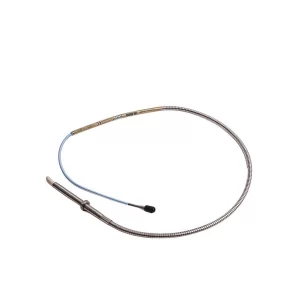
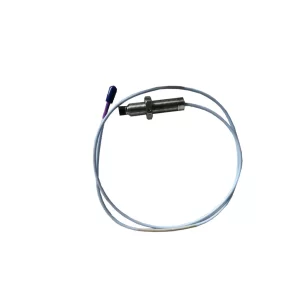
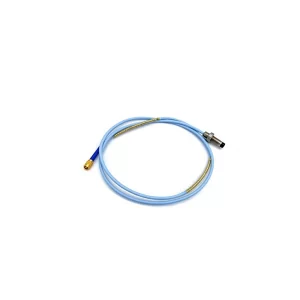
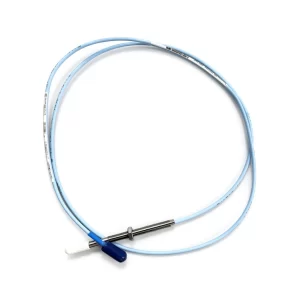
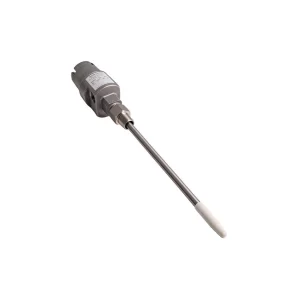
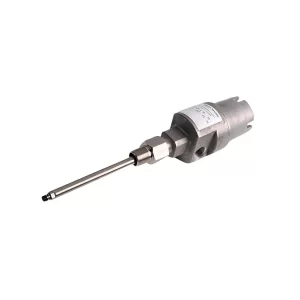
Radial vibration is the only 3500/42M channel type that returns all eight static values, and Smax still requires an orthogonal pair. Image: TenBN.
What does the 3500/42M actually measure?
The Bently Nevada 3500/42M Proximitor/Seismic Monitor is a four-channel card that accepts from one to four proximity, velocity or acceleration transducer signals. It conditions each input into vibration and position measurements, compares those measurements with user-programmable alarms, and sends the results to the rack interface and to four per-channel 4–20 mA recorder outputs.
The important architectural detail is that channels are programmed in pairs. Channels 1 and 2 run one function; channels 3 and 4 run the same function or a different one. A single card therefore supports up to two function types at once, not four. The nine functions listed in datasheet 143694 are radial vibration, REBAM, thrust position, acceleration, differential expansion, shaft absolute, eccentricity, circular acceptance region and velocity.
That pairing rule is also the reason the “eight values per channel” claim needs a footnote. The values are generated by the configured channel type, and one of the eight is shared across the pair.
Which static values does each channel function return?
The table below reproduces the static-value list from datasheet 143694 Rev. AE. “Static value” is Bently Nevada’s term; the same measurements are also called proportional values, or PPLs, in the 3500 documentation.
| Channel function | Static values returned | Practical note |
|---|---|---|
| Radial vibration | Direct, Gap, 1X amplitude, 1X phase lag, 2X amplitude, 2X phase lag, Not 1X amplitude, Smax amplitude | Eight values; Smax is returned once per pair, on channel 1 or 3 |
| Thrust position | Direct, Gap | Position only; no order tracking |
| Differential expansion | Direct, Gap | Position only |
| Eccentricity | Peak-to-peak, Gap, Direct minimum, Direct maximum | Four values, not eight |
| REBAM | Spike, Element, Rotor, Direct, Gap, 1X amplitude, 1X phase lag | Seven values; 1X only |
| Acceleration | Direct only, defined as RMS acceleration, peak acceleration, RMS velocity, peak velocity, band-pass peak acceleration or band-pass peak velocity | No 1X/2X on the basic type |
| Acceleration II | Direct, 1X amplitude, 2X amplitude, plus 1X phase, 2X phase and bias voltage | This is the type that adds order tracking to a seismic channel |
| Velocity | Direct only, defined as RMS velocity, peak velocity, peak-to-peak displacement, band-pass peak velocity, band-pass or peak-to-peak displacement | No 1X/2X on the basic type |
| Velocity II | Direct, 1X amplitude, 2X amplitude, plus 1X phase, 2X phase and bias voltage | Order tracking for a Velomitor-type channel |
| Shaft absolute, radial vibration or velocity | Direct, Gap, 1X amplitude, 1X phase lag | Four values; no 2X, Not 1X or Smax |
| Circular acceptance region | Direct, Gap, 1X amplitude, 1X phase lag, 1X circular acceptance radius, 2X amplitude, 2X phase lag, 2X circular acceptance radius | Eight values, but the radius replaces Smax and Not 1X |
Two conclusions follow. First, “eight values” is a radial-vibration statement; it does not apply to thrust, differential expansion, eccentricity or the basic acceleration and velocity types. Second, the eight-value list is not a generic description of the card. It is one channel type out of eleven configurations listed in the datasheet.
What are the eight radial-vibration values, one by one?
The definitions below follow the 3500/42 Operation and Maintenance Manual. They matter because the names are often shortened in sales material, and the shortening changes what the value actually is.
| Value | What the monitor returns | Filter / validity in the datasheet |
|---|---|---|
| Direct | Broadband vibration amplitude, the “overall” value most operators watch | User-programmable single-pole filter, −3 dB at 4–4000 Hz or 1–600 Hz |
| Gap | DC gap voltage of the proximity probe, used to judge probe position and target condition | Filter −3 dB at 0.09 Hz |
| 1X amplitude | Amplitude of the component at shaft running speed | Constant-Q vector filter, minimum stopband rejection −57.7 dB |
| 1X phase lag | Phase lag at running speed, referenced to the Keyphasor pulse — not an absolute angle | Same vector filter; requires a valid Keyphasor |
| 2X amplitude | Amplitude of the component at twice running speed, the classic misalignment and looseness indicator | Constant-Q vector filter, −57.7 dB |
| 2X phase lag | Phase lag of the 2X component, measured from the Keyphasor pulse to the following positive peak | Same vector filter; requires a valid Keyphasor |
| Not 1X amplitude | Amplitude of everything that is not running speed — the residual after the 1X component is rejected | Constant-Q notch filter from 60 cpm to 15.8× running speed, minimum rejection −34.9 dB |
| Smax amplitude | Single peak of the unfiltered X/Y orthogonal pair, in the measurement planes, against a calculated “quasi zero” point | Specified from 0.125 to 15.8× running speed; accuracy within ±5% maximum |
Note the naming precision. The manual calls the phase values phase lag, not phase. A phase lag is referenced to the Keyphasor edge; if the Keyphasor is invalid, the 1X and 2X values are defeated along with Not 1X, and their alarms are bypassed. That behaviour is documented in the O&M manual and is worth knowing before a technician concludes that a channel has failed.
Is Smax calculated per channel or per pair?
Per pair. Smax is computed inside the 3500/42M from two orthogonal proximity probes, but the manual is explicit that “only one Smax amplitude value is returned per channel pair (channel 1 or channel 3).” It is a single peak measurement of the unfiltered X/Y pair against a calculated quasi-zero point, accurate to within ±5% maximum.
That has three consequences for a bill of materials or a tag list:
- Both channels in the pair must be configured for radial vibration. A pair split between radial vibration and thrust position cannot produce Smax.
- A four-channel card configured entirely for radial vibration returns eight values on channel 1, seven on channel 2, eight on channel 3 and seven on channel 4 — 30 unique static values, not the 32 that a simple “8 × 4” multiplication suggests.
- If you need Smax on two bearing planes, you need two pairs, which means a full four-channel card. You cannot get two independent Smax values from a single pair.
Smax also appears in the alarm list as a normal static value: it can carry an Alert setpoint and, if selected, one of the two Danger setpoints for that channel.
Is Not 1X simply overall minus 1X?
No. It is a filtered measurement, not an arithmetic subtraction. The datasheet specifies a constant-Q notch filter that tracks running speed from 60 cpm to 15.8 times running speed, with a minimum stopband rejection of −34.9 dB. What the monitor reports is the amplitude that survives that notch, which is why the accuracy figures are quoted separately: ±3% for machine speeds below 30,000 cpm and ±8.5% above 30,000 cpm.
This distinction matters when someone tries to reconcile a 3500 reading with a portable analyzer. A spectrum-based “1X removed” calculation and a hardware notch filter will not produce identical numbers at the edges of the band, because the filter has a finite stopband and a Q that changes with speed. The 42M value is the one the protection logic uses; the analyzer value is a diagnostic cross-check, not a substitute.
Not 1X is also amplitude-only. The eight-value list contains no “Not 1X phase”, and the datasheet does not define one.
Can one channel trip on any combination of the eight values?
Partly. The datasheet draws a line between Alert and Danger:
- Alert: a setpoint can be configured for every active static value. All eight can therefore raise an Alert.
- Danger: setpoints can be configured for any two of the active static values on that channel. Not eight.
Both are threshold comparisons against the conditioned value. Within the card, a channel’s Danger status is the OR of the selected Danger setpoints — if either of the two exceeds its limit, the channel goes to Danger. There is no AND term, no two-out-of-three term and no cross-channel term inside the 42M alarm engine.
The setpoint range is 0–100% of full scale for each measured value, with the transducer range limiting the setting when full scale exceeds it. Setpoint accuracy is within 0.13% of the desired value. Alert delays are programmable from 1 to 60 seconds in one-second steps; Danger delays are 0.1 second or 1 to 60 seconds in 0.5-second steps. REBAM channels are the exception, with delays up to 400 seconds. All of this is configured in the 3500 Rack Configuration Software and stored in the rack interface.
So the honest description of a 42M channel is: eight measurements, eight Alert thresholds, and two Danger thresholds expressed as an OR. Calling that “multi-parameter cross logic interlock trip” overstates what the card does by itself.
Where does multi-parameter cross-channel voting actually happen?
In the 3500/32M 4-Channel Relay Module. This is the module that turns monitor statuses into contact closures, and its alarm-drive logic is where AND/OR voting is configured.
The 3500/32M datasheet (141533) states that each of its four relay outputs can be independently programmed to perform voting logic, and that the alarm-drive logic uses AND and OR and can use alarming inputs — Alert and Danger statuses, Not-OK, or individual PPLs — from any monitor channel or any combination of monitor channels in the rack. That is the cross-channel and cross-module capability. It is configured in the same rack configuration software and executed by the relay module, not by the 42M card.
Three practical points follow:
- Cross-channel: a relay can combine, for example, the Danger status of channel 1 with the Alert status of channel 3, or with a PPL from a different module entirely.
- Cross-module: the inputs are not limited to the 42M. Any monitor channel in the rack can feed the logic, which is how a vibration condition can be combined with a temperature or speed condition.
- Module dependency: the 3500/32M requires a 3500/22M Transient Data Interface and Rack Configuration Software version 4.5 or later. It is a full-height module and must sit in a slot to the right of the TDI.
For redundant machines, the TMR relay module adds 2-out-of-3 voting: the selected alarm outputs of three monitors are compared and two must agree before the relay is driven. The 42M O&M manual also describes a second layer, “comparison voting”, which compares the proportional values of the three monitors and logs a system event when one drifts outside a configured percentage of the middle value.
Claim versus manual: the eight-value story, checked line by line
Product summaries tend to compress several true statements into one sentence. Here is the same claim, item by item, against the two primary documents.
| Claim | What the manual says | Verdict |
|---|---|---|
| “One channel outputs eight characteristic values” | Radial vibration returns Direct, Gap, 1X amplitude, 1X phase lag, 2X amplitude, 2X phase lag, Not 1X amplitude and Smax amplitude | Correct, for a radial-vibration channel |
| “Total vibration, gap voltage, 1X amplitude/phase, 2X amplitude/phase, non-fundamental, Smax” | The same eight, with the phase values named phase lag | Correct, with a naming caveat |
| “Four channels × eight values = 32 measurements” | Smax is one value per pair, returned on channel 1 or 3 | Overstated by two: 30 unique values on a fully radial card |
| “Smax is computed by the monitor” | Single peak of unfiltered XY orthogonal probes against a quasi-zero point, ±5% maximum | Correct, but requires a radial pair |
| “Supports multi-parameter cross logic interlock trip” | 42M: Alert on each value, Danger on any two per channel. AND/OR combining is a 3500/32M relay function | Half right: the capability exists in the rack, not in the card |
| “1X/2X amplitude and phase are standard” | Standard on radial vibration and circular acceptance region; also on Acceleration II and Velocity II; not on basic Acceleration, Velocity or Shaft Absolute | Channel-type dependent |
| “Not 1X is the overall value minus 1X” | Constant-Q notch filter, 60 cpm to 15.8× running speed, −34.9 dB minimum rejection | Wrong mechanism: filtering, not subtraction |
Claims that could not be checked against either document — the size of the installed base, or a generic statement about “computing power” — are not repeated here. The 42M’s processing capability is a fact of architecture: it performs the filtering, vector extraction and Smax calculation on the card, and presents the results as static values. That is verifiable from the static-value list. “Most installed” and “most powerful” are not.
What this means when you specify or replace a 3500/42M
Four checks cover most of the mistakes we see on retrofit lists.
1. The I/O module decides which sensors you can connect. The front card is the same part in every 42M; the rear I/O module determines whether the slot is proximity-only, proximity plus seismic, internal or external termination, or barrier-protected. A 42M ordered with the wrong I/O cannot be fixed by configuration.
2. Pairing decides the function count. If the tag list asks for radial vibration on two bearings plus thrust position, that is two functions and fits one card. If it asks for four different function types, it does not.
3. 1X/2X phase needs a Keyphasor. The 3500/25 Keyphasor module supplies the reference edge. Without a valid Keyphasor, the speed-related values are defeated and their alarms are bypassed — the channel may look “dead” while the probe and card are healthy.
4. Trip logic is a separate module. If the protection philosophy calls for AND/OR combinations across channels or modules, budget for a 3500/32M relay module and a 3500/22M Transient Data Interface, and write the logic in the rack configuration. Do not expect the 42M to do it.
For the probe side of the same loop, the 3300 XL 8 mm probe family is the usual match for radial vibration and thrust position. Rack power comes from the 3500/15 power supply, and the rack-level architecture is covered in the 3500 system guide.
On availability, the 3500/42-01-02 inventory note covers the standard internal-termination configuration, while the 3500/42M and 3500/15 spot-stock verification explains how we read a distributor stock notice before quoting a lead time. If you are matching a card to an existing tag, send us the full model string and the I/O part number and we will confirm the pairing and the sensor mix.
FAQ
How many measurements does one 3500/42M radial-vibration channel provide?
Eight static values: Direct, Gap, 1X amplitude, 1X phase lag, 2X amplitude, 2X phase lag, Not 1X amplitude and Smax amplitude. Seven are returned by the channel itself; Smax is returned once per channel pair, on channel 1 or channel 3.
Does the 3500/42M calculate Smax itself?
Yes. Smax is computed by the monitor from two orthogonal, unfiltered proximity probes in the same pair, against a calculated quasi-zero point. Accuracy is within ±5% maximum, and only one Smax value is returned per pair. Both channels in the pair must be configured for radial vibration.
Is Not 1X the same as overall vibration minus 1X?
No. Not 1X is a filtered measurement: a constant-Q notch filter tracks running speed from 60 cpm to 15.8 times running speed and rejects the 1X component with at least −34.9 dB attenuation. It is amplitude-only, with ±3% accuracy below 30,000 cpm and ±8.5% above.
Can the 3500/42M vote two-out-of-three or AND/OR across channels?
Not by itself. The 42M provides an Alert setpoint for each active value and a Danger setpoint for any two values per channel, and the channel Danger status is an OR of those thresholds. Cross-channel and cross-module AND/OR voting is configured in the 3500/32M relay module, which can use Alert, Danger, Not-OK and individual PPLs from any monitor channel or combination in the rack. Two-out-of-three voting is a TMR relay function.
Do all 3500/42M channel types provide 1X and 2X?
No. Radial vibration and circular acceptance region provide 1X and 2X amplitude and phase lag. Acceleration II and Velocity II add 1X/2X amplitude and phase to the basic direct value. The basic Acceleration and Velocity types provide only a direct value, and Shaft Absolute provides Direct, Gap, 1X amplitude and 1X phase lag — no 2X, Not 1X or Smax.
What does an eight-value radial channel need from the rest of the rack?
A valid Keyphasor for the 1X/2X phase lag and Not 1X values, a second orthogonal probe in the same pair for Smax, rack configuration software to set the channel type and setpoints, and a 3500/32M relay module if the trip logic needs AND/OR combinations across channels or modules.
Sources
- Baker Hughes, 3500/42M Proximitor Seismic Monitor Datasheet, 143694 Rev. AE — four-channel input, paired channel programming, nine configurable functions, static-value list, filter ranges, accuracy, alarm setpoints and delays.
- Bently Nevada, 3500/42 Proximitor/Seismic Monitor Module Operation and Maintenance Manual, 129773-01 — definitions of 1X/2X phase lag, Not 1X, Smax and the one-per-pair Smax rule; alert and danger setpoint behaviour; TMR comparison voting.
- Baker Hughes, 3500/32M 4-Channel Relay Module Datasheet, 141533 — four independently programmable relay outputs, AND/OR alarm-drive logic, inputs from any monitor channel or combination in the rack, TDI and software requirements.
- Baker Hughes, 3500 Machinery Protection System product page — rack-level description of the 3500/32M relay logic and the monitoring functions available across the 3500 family.
TenBN supplies Bently Nevada 3500 monitoring hardware — 3500/42M monitors and I/O modules, Keyphasor and relay modules, power supplies, proximity probes and interconnect cables — to plants maintaining installed protection systems. If you are matching a replacement card to an existing rack or tag, send us the model string and we will confirm the I/O pairing and availability.